46. Point-to-Point Courses: Face Your Fears to Grow as a Runner
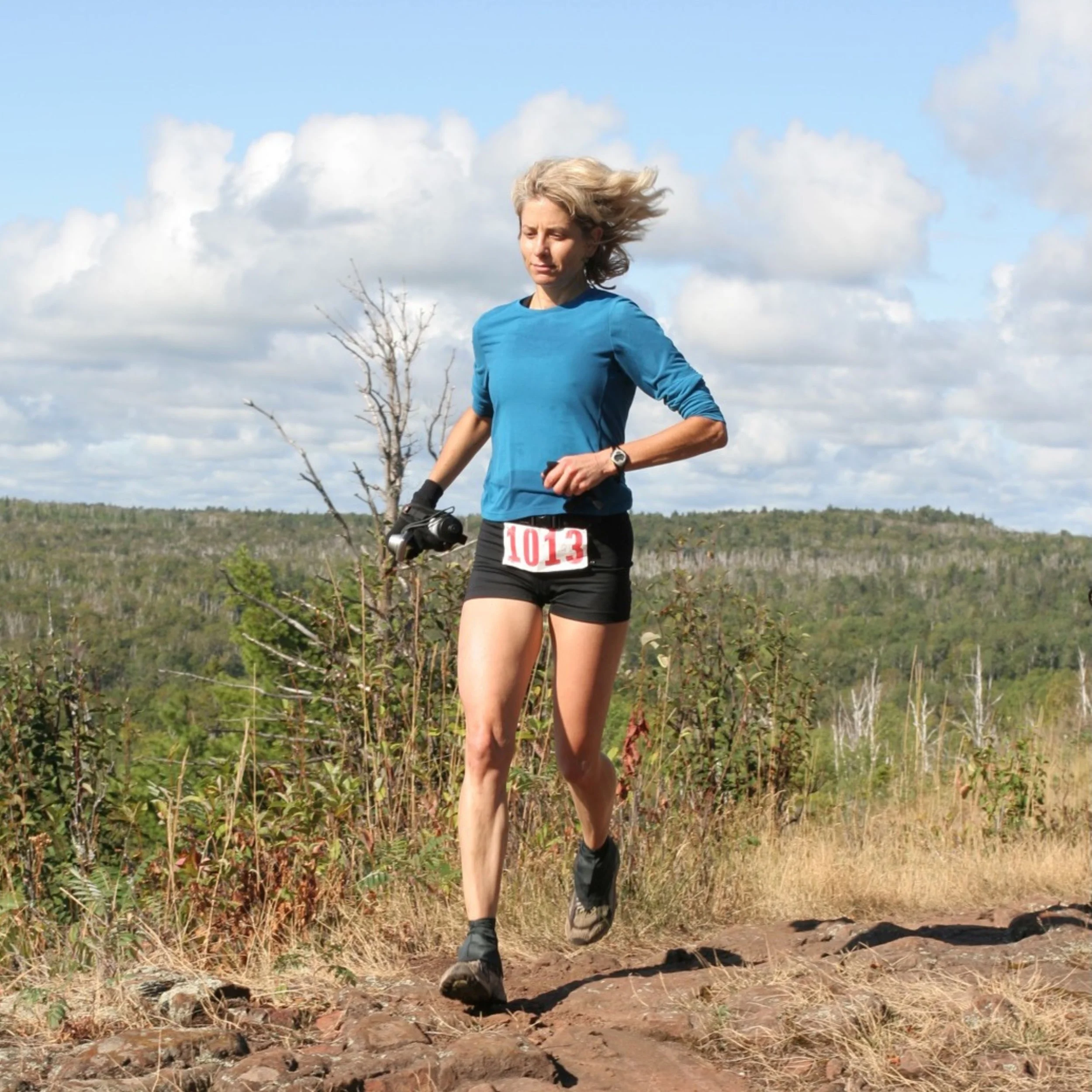
What if the only thing standing between you and the race you really want to run is fear of the unknown? In this episode, I’m breaking down the fears that keep runners avoiding point-to-point courses and showing you why those fears are not facts. If you’ve been defaulting back to loop races because they feel safer, simpler, or easier to plan, this conversation will help you see point-to-point races in a completely different light.
Point-to-point courses often feel intimidating because you do not know what is ahead, aid stations are spaced differently, drop bags take more planning, crew logistics feel complicated, and you might spend more time alone. But none of those things are actual problems. They are opportunities. Opportunities to plan better, trust yourself more, become more self-sufficient, and stay mentally engaged instead of drifting into autopilot.
In this episode, I walk you through how to rethink the unknown, level up your race planning, rely on drop bags instead of pressure on your crew, handle wildlife fears logically, and even see night miles as peaceful instead of scary. Facing your fears about point-to-point races is not about forcing yourself to suffer. It is about expanding what you believe you are capable of and choosing the race you actually want to run.
If you’re loving the show, please take a moment to follow, rate, and review wherever you listen to podcasts today!
What You’ll Learn from this Episode:
Why fear of the unknown is really fear of imagined problems.
How point-to-point courses can sharpen your focus instead of overwhelm you.
A smarter way to plan drop bags so you are not guessing.
How to take pressure off your crew and build self-sufficiency.
The truth about wildlife risk versus what your brain tells you.
Why being alone on course can become a tactical advantage.
A simple exercise to help you choose and plan the point-to-point race you keep postponing.
Listen to the Full Episode:
Featured on the Show:
If you’re loving the show, please take a moment to follow, rate, and review wherever you listen to podcasts today!
Episodes Related to Point-to-Point Course Fear:
Full Episode Transcript:
Welcome to Unstoppable Ultra Runner, the podcast for ultra runners who refuse to let anything hold them back. I’m your host, Susan Donnelly, veteran of over 150 100-mile races, and a coach who helps runners like you break through mental roadblocks, push past doubt, and run with confidence. Let’s go.
Hi, and welcome to episode 46. A couple of weeks ago, I did an episode about loop courses because a lot of runners worry that they'll be bored, and they don't have to be. They're actually really fun. So today, I'm talking about the opposite: point-to-point courses, because a lot of runners also find these intimidating, for different reasons, of course. And even if you already love point-to-point races like I do, this episode will make you fall in love with them even more.
But first, here's what I'm calling point-to-point. For this episode, I'm not just talking about a straight line course like Superior 100 that you could almost draw with a ruler. It's that straight and in a line. I'm also talking about any course that runs from one point to another without significantly repeating, like Moab 240 or UTMB, which are both one giant loop, or Massanutten 100, a figure-eight course with only a tiny little bit of overlap in the middle. Basically, a course where you, the runner, while you're out there on the course, feel like you're running from start to finish through new territory all the time without repeating loops or out-and-backs.
These courses intimidate some runners, and here's why runners say point-to-point races are scarier. You don't know what's ahead. You don't know how long it will take you to get from one aid station to the next. It'll be harder for crew to get to you if you do have a crew, and you're going to have to plan drop bags better. Drop bags become way more complicated because if you guess wrong about how fast or slow you're going to be moving, you might not have the correct clothes or headlamp or gear in the right places. And you're also going to be more alone. You'll see fewer other runners the longer the race goes on, and people spread out more on the course. So, loop courses seem safer and easier and simpler.
Like a runner I talked to about this episode told me, "I like doing races without crew or pacers, so looped courses make me feel better about that because they're easier to plan for, and by the time night falls, you know what's coming up ahead." And she also remarked that her resistance to point-to-point courses all comes down to, once she thought about it, fear of the unknown. But that fear of the unknown keeps runners like her stuck in a comfort zone that eventually starts feeling like a prison.
They're drawn to a point-to-point race, but that fear keeps them from venturing out of their comfort zone to do it. They default back to another loop course, like maybe next year, they think, when it feels more comfortable, or the year after that. And when they're doing that, when they're thinking that and avoiding those races, they miss years of doing races that they actually want to do and never get out of that comfort zone loop at all.
And look, you don't have to run point-to-point courses to be a real ultra runner, and one course type is not better than another. They're just different. But if this fear is holding you back, it's really time to solve it and get it out of your way.
So, the solution, the way forward here, is to reexamine the scary way you see point-to-point courses. Take the same course and change your perspective, not the course, because you're seeing it one way, while there are other, honestly, true ways to see a point-to-point course that are exciting, intriguing, and freeing. And I'm not talking here about finding a way to grit your teeth and pretend you're not scared and force yourself to do one, but actually investigating the general way you see point-to-point courses right now, the way that's holding you back, to actually see what's fabulous about them and to fall in love with them.
And to get there, what we're going to do in this episode is dissect the specific fears about this type of course one by one, starting with the most common fear: not knowing what's ahead. This fear isn't because you can't know whether a climb or a sandy section or a hot exposed section is ahead. I mean, you have maps and course descriptions, so you can know what's going to be ahead before race day. This only seems scary because you expect problems or difficulties ahead. It's not necessarily that there's another problem ahead; it's that there's likely new ones ahead, and you don't know what it is, and you can't prepare for it.
So it seems like on loop courses that once you know the tough part of a loop, you can relax because you know all the problems. You know how what is ahead, and you're not going to be surprised by a problem. But that's not necessarily true. New problems can appear at any time on a loop course, too. So there's really no difference there between the two types of courses. And imagining that you're going to face more problems in a point-to-point course is really just an assumption with no facts to back it up.
Think about this: in a loop course, you might face a difficult, rocky part every single loop. It's just going to be there every loop. You can't get away from it. And in a point-to-point course, where things are changing all the time, there might actually be fewer problems to face like that rather than more.
The other part of what's scary about not knowing what's ahead is that you don't trust yourself to respond confidently and figure out a solution to whatever is ahead. But like I said, new problems come up all the time in races, no matter what format you're running. If you can solve problems in a loop course, you can solve them in a point-to-point course.
So, not knowing what's ahead isn't just not a problem; it can actually be to your advantage. Think about this: the anticipation of the unknown ahead keeps your mind fresh, keeps your attention up, which is a really good. So you can't tune out and go on autopilot. It's easier to stay present and on top of your race, and it's the same with navigation. You can't afford to go on autopilot, which is a good thing. You have to keep part of your attention on where you're going and what you're doing and staying on course. And when was the last time you saw a course marker and all of that? So you can't just drift off into la-la land and not pay attention to your pacing and all that.
And the variety, the constant newness ahead, is definitely not boring. The change of scenery, new hills and descents, new terrain, new views. A course like No Business 100, for example, takes you past an incredible number of rock arches and these wide caves called Indian rock houses, along with gorge views and woods and rivers and state park buildings built by the Civilian Conservation Corps across an insanely high bridge and past historic coal mining sites, all of that. A loop course could take you on only a tiny fraction of that. By the time you get done with the race with no business, you've explored a good portion of not only a national park but a state park as well.
The variety in the course also means that if the course is muddy or difficult in some way, you probably won't be running through that difficulty, that mud, the entire time because of the variety. You'll eventually get to a dry or a smooth part.
And for me, of course, the best part of not knowing what's ahead is exactly that. It's the what's-around-the-corner factor. I can't resist one more section. I want to see what's there. I want to see the whole course. I'm wondering what's in the next section, like what's going to be there? What views am I going to have? What am I going to find there? My curiosity pulls me forward, and I have to satisfy it one corner after another until the finish line. It's an irresistibly powerful force you almost have to stop to keep it from pulling you forward, which is super helpful in a race.
And if that's not enough, racing a point-to-point course feels like you have a purpose. I'm headed somewhere. I'm running toward a destination. I'm running back to my car. And I have this reassuring sense of distance traveled and making progress. It's so satisfying. To me, this makes a point-to-point course mentally easier than any other format.
So, the next thing runners say that makes them scared about a point-to-point is not knowing how long it's going to take you to get from one aid station to the next. It means you have to plan drop bags better. You have to put thought into them. And you worry—I understand this—you worry that you're going to guess wrong about how fast you're going to be moving and might not make it to a drop bag in time to get the correct clothes or headlamp or other supplies, whatever you need, when you need them. And that's certainly happened to me.
But the solution for all of this is really simple: Plan your race, including your drop bags, so there's no guessing. When I help my clients create a comprehensive race plan, we take everything into account. We estimate how long each section will take and which aid stations they'll hit at night or in the heat of the day, so they know what to pack in which drop bag. And I know what you're thinking, "What if you still get it wrong?" We also plan for what if your plan is wrong. What if you're off by an aid station or two? We plan for worst-case scenario. So when you're done planning, you can relax and feel confident that you've planned your best and covered all bases and the what-ifs.
A point-to-point course presents the opportunity here to level your race planning up, to make decisions instead of putting them off because you don't have to in a loop course. And to me, race planning is tremendous fun. To me, it's like a puzzle, and I love putting the pieces together to make them work the best. And a point-to-point course levels up the difficulty here in a very satisfying way. It makes the puzzle a little bit more challenging and a little bit more fun to figure out. The bottom line here is that you don't have to guess about aid stations and drop bags. You can plan.
The next worry I hear is that a point-to-point course may also be harder for crew to get to you if you have a crew. And that's true. It can be more complicated and take more work for a crew to reach you at aid stations. And sometimes crews can't make it to the aid station on time, like they have a flat tire or a dead battery or there's flooded roads. I have heard all of those happen. But that doesn't have to be a problem for you either. It doesn't have to mean that you can't have what you need and that your race is over. It just means your crew couldn't get to you at that aid station because you can still have what you need in drop bags. That's why they're there.
Point-to-point courses are an opportunity here to become more self-sufficient, like you've been wanting to. I hear that all the time. Point-to-point courses are the perfect opportunity to take a step toward building your experience with drop bags before you go for a race solo. And you don't even have to be totally self-sufficient. You have volunteers there to help. If your crew gets to the aid station, great. It'll be a treat to see them. But if not, you're going to be fine. And they can catch you at the next one. Besides, you have drop bags, so it's really not fair to put the responsibility for the success of your race on your crew. Rely on your drop bags so the pressure is off your crew to be there, and you can be delighted to see them when they are there in the aid station.
The next problem runners anticipate with a point-to-point course is seeing fewer other runners, being more alone. And that also might be true. The longer the race, the more spaced-out runners get, and of course, some runners are going to drop along the way. So the further you go, the more likely you are to be alone some of the time. And to some of us, that's not a problem. It's just fine. In fact, it's a great thing. Plenty of runners like the peace and quiet of running mostly by themselves, including me.
But even in a point-to-point race, you're not necessarily going to be alone, even if you want to. For example, at Superior 100—and I'm talking this is like an almost straight-line course from start to finish up the shore of Lake Superior—there's not much opportunity for truly being alone. In fact, there's one section where I wait for it every race now because if everything lines up right, I get to pretend I'm the only one out there in the wild North Woods and listen to the sounds at night and hear the rivers and, if I'm lucky, wolves, and stop to look at the stars for a moment. And notice, that's just one section, and things have to line up perfectly for that to happen on a course where I'm alone, where I can't hear or see any other runners. And very often, they don't line up that way. Some years, there are always runners within sight or within hearing on that section.
So that's one thing. And some races, think about this, also have other race distances that reduce your aloneness. Superior also has a 50-mile and a marathon. Those runners start after the 100-mile runners have already been on the course for 50 miles or more so that we all end up finishing together. It's timed that way. And that also means that as the 100-mile runners might be spacing further and further apart later in the race, the gaps end up being filled by the more plentiful 50-mile runners and marathoners.
And sometimes, it's a tactical advantage to have fewer people around. If the course is muddy, you're not rechurning the mud up along with everybody else every lap. If there are 100 runners in the race, the mud is only being chewed up 100 times, or by two feet times 100 runners, but not 100 runners 10 times for 10 loops. And it's not just mud. On technical trail, there's also less work passing and being passed, less feeling rushed on the tricky parts.
And don't forget, you don't necessarily have to be alone. If you're worried about being alone, you can usually have a pacer after a certain mile or time, like 50 miles into a 100-mile race where runners are spaced further apart.
One more fear of point-to-point courses is wildlife, and not the fluffy bunny kind here. The fear here is twofold: that you have more chance of encountering wildlife and then not knowing what to do when you do encounter them. And yes, you might meet wildlife on a point-to-point course, but this is also not the sole province of point-to-point courses. You're just as likely to see wildlife on loop courses as well.
Like, I've seen coyotes and rattlesnakes at Havelina 100, a loop course in the desert with a ton of people in it, and bears, oddly, running alongside a fellow runner and I at Viaduct Trail, which is a repeat out-and-back course in Pennsylvania. I almost got run over by a bolting deer once at Crimea River 100, which is also a repeat loop course. And also at Crimea River, now that I think about it, we were running through city parks. They were overflowing with raccoons. There were raccoons all over the place at night. And so plenty of opportunity to run into raccoons, too.
Now on point-to-point courses, I've seen a bear and I've heard another in two 100-mile races out of 153. I've seen rattlesnakes at Massanutten and Eastern States 100. I've seen a moose one night, asleep, on its feet, and heard wolves and coyotes at Superior 100 but never seen them. So you might very well see wildlife on a point-to-point course, but you have an equal chance, really, as you do on a loop course.
And as far as knowing what to do, you don't have to. But if you really want to get past the fear of not knowing what to do when you meet wildlife, the solution is to learn. Learn what wildlife you're likely to encounter in a race, in the specific race you've picked out, and for those animals, learn how to avoid problems and what to do if you should meet them, especially when nobody else is around. There's tons of practical information out there, and learning it, whether you ever need it or not, can calm that fear down because you know what to do.
And also, here's something my dad taught me. Investigate your relative risk of a bad wildlife encounter on a course, so you actually know what the risk level is. You have something like a 1,000 to one or greater difference in risk of getting a tick-borne disease than being attacked by a coyote. And coyote attacks on humans are extremely rare and generally only happen around civilization. And even with bears, AI says that if you spent 100 years running trails—now that's 100 years on trail, which we're not doing—you'd almost certainly get at least one tick-borne illness somewhere in there. But the odds of a bear attack over that same period of 100 years of running trails would still be slim compared to the tick-borne illnesses. They're just not even in the same risk universe. So, you're scared about the wrong things.
And if you look at it from another angle, your car ride to the race is roughly 50 to 200 times more dangerous than the wild animal environment that you're going to be running through in a point-to-point race. The most dangerous part of most races, whether it's a loop course or a spaghetti bowl or point-to-point, is the drive to the starting line. I've never been attacked by a wild animal on a course, but I've been in a potentially fatal car wreck on the way to Massanutten 100. So, like the other fears we've talked through here, a point-to-point course is an opportunity to level up your trust in yourself to handle this, too.
And lastly, night seems like it should add an extra amount of scariness to the already scary point-to-point course because it amplifies all the other fears we've already talked through. You don't know what's coming up ahead or whether your crew will be able to meet you or whether you'll meet a wild animal that could hurt you. And it's also dark. So you can't see as much around you. And what I'll say for this one is that everything I've covered already is just as true during the night as during the day. You can't see as much around you, but you don't have to fear a point-to-point course anymore. And at night, I think it's extra quiet and peaceful and magical.
And also, this is when a sense of awe, of being part of a bigger universe, a small, tiny little bit of a vast universe, is far more accessible to me at night on a point-to-point course when there's not that many other people around. So night doesn't have to be a problem either. It's just a change of scenery and experience that keeps it fresh.
To sum it up, don't let unexamined fears keep you from the races you actually want to do. Here's what I want you to do from this episode. Pick one specific point-to-point race you've been dreaming about, the one that you keep saying, "Maybe next year, maybe next year," about. You can even find one like Daytona 100, which is a more urban point-to-point along the Atlantic coast of Florida, as a way to ease into point-to-point races instead of diving straight in, as a way to ease into challenging your fears.
Now, once you've picked your race out, go through your actual fears about that specific course, not general worries about some general point-to-point course, but real concerns about that point-to-point race. Check out the course map and description. Look at the aid station spacing. Check overall and aid station cutoffs. See where you can have a drop bag and where crew and pacers can meet you.
Go through the logistics on how to get to the start or the finish if that's an issue. Think about the problems you're likely to have, whether it's navigation, weather, climbs, descents, gear, wildlife, heat, and how you'd solve each one of those. These are all things I do helping my clients plan for a race. And I bet, like my clients, you'll find that most of your fears either aren't true for that race, or there are simple solutions you just hadn't considered. And solving these problems, even in your head, builds your confidence. It's not as scary as you thought. It's actually very doable.
Because here's the powerful thought I want to leave you with. Loop courses and point-to-point courses aren't better or worse than each other. They're just different ways to experience ultra running in ways that build different mental muscles. If you only ever run one type because another type intimidates you, you're limiting your growth as a runner. And you're definitely limiting the races available to you and the community of runners you're going to meet. I have some friends that I only see in loop races and some friends I only see in point-to-point type courses.
So stop waiting for point-to-point courses to feel comfortable on their own. They won't. That's the point. You need to challenge your fears about them. Growth happens when you look at your fears and venture outside your comfort zone, and you can do that smart. Pick the race, do the planning, and discover that point-to-point courses aren't just manageable, they're incredible.
All right, you all. That's this week's episode. Thanks for listening. If you know somebody who could use this, please share it with them. It might be exactly what they need to hear.
See you all next week. Bye.
Thanks for listening to Unstoppable Ultra Runner. If you want more ultra talk, mindset tools, and strategies for running with confidence, visit www.susanidonnelly.com. This podcast receives production support from the team at Digital Freedom Productions. That’s it for today’s episode. See you next week.
Enjoy the Show?
Don’t miss an episode, follow the podcast on Apple Podcasts, Spotify, RSS, or wherever you listen to podcasts!